
Let's start with a blunt observation: many people spend money on self-development yet do not get richer in life. They study a lot and still flounder, read a lot and still cannot decide, know a lot and still repeat. The reason is not laziness. It is that they invest in information while what's missing is clarity.
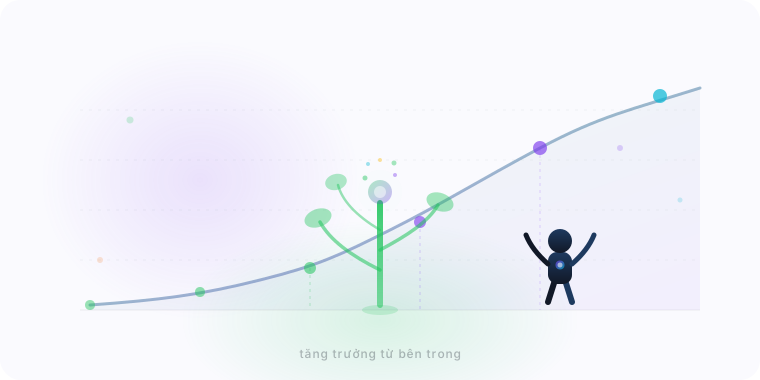
Information answers "how". Clarity answers "why and for whom". When you buy more information without clarity, you only thicken a warehouse with no manager. This article proposes a shift: see yourself as a portfolio of capital to be managed, and see clarity as the highest form of interest.
Five forms of inner capital
You don't only have money. You hold five forms of capital, and most people go bankrupt in the non-money ones without knowing it.
- Attention capital. The total quality focus you have each day. The scarcest capital, and the most often stolen.
- Energy capital. Physical state, sleep, emotional state. Without it, every other capital loses value.
- Skill capital. Real value-creating capability, distinct from decorative credentials.
- Relationship capital. A network of two-way trust, not a contact list.
- Clarity capital. How well you know what you want, what you fear, where you're going. The capital that coordinates all the rest.
The key: clarity capital is a multiplier, not an addition. When it rises, every other capital rises geometrically, because you stop pouring attention, energy and money into the wrong places. When it's low, you can be very hard-working and still grow steadily poorer.
How the interest of clarity is paid
Clarity earns interest through three very concrete mechanisms:
- Cutting losses early. A clear person stops a wrong path after a few weeks; a foggy person drags it for years. These savings are huge and invisible.
- Lowering the cost of hesitation. Every suspended decision drains background energy. Clarity releases that energy back to value creation.
- Raising the hit rate. When you know what you truly want, you pick the right opportunity instead of chasing every one. Fewer moves, higher results.
A decision filter for investing in yourself
Before spending money or time on any "self-development", run it through these four questions. If you can't answer three of four, postpone.
- Which capital does this grow? If you can't name it, it's consumption, not investment.
- What behavior will it change in the next 30 days? If the answer is only "know more", the interest will be very low.
- Am I buying from clarity or from anxiety? Buying from fear (of falling behind, of missing out) almost always loses.
- Have I used up the similar thing I already bought? If the warehouse is full of unused items, the new one only thickens it.
A 90-day inner-investment path
Inner investment needs no large capital, but it needs a term. Here is a 90-day cycle — long enough to see interest, short enough not to drift.
- Month 1 · Audit. Build a balance sheet of your five capitals: where you have surplus, where you're depleted, where you're leaking. Find the single biggest leak (usually attention or energy) and seal it.
- Month 2 · Allocate. Choose exactly one investment that passes the four-question filter, and one thing to stop. Investing means both adding and subtracting.
- Month 3 · Compound. Turn the chosen investment into a weekly rhythm. Re-measure the balance sheet. The interest shows up where you decide faster, tire less, and get less distracted.
A one-line capital balance sheet
This week, my [type] capital is leaking through [activity]. I will seal the leak with [action], and reinvest that amount into [value-creating work].
Four costly misconceptions
- "The more I learn, the better." Past a threshold, learning more only delays doing. Learn just enough to start, then learn from reality.
- "Investing in yourself is about a dramatic turnaround." No. It's about stopping leaks and choosing the right place — far more durable than a leap.
- "I'm out of money, so I can't invest yet." The highest interest is clarity, energy and attention — none require money.
- "I'm too busy, so later." Busy is usually a symptom of low clarity capital, not a reason to postpone it.
This piece shares a way of thinking about self-management, not financial or investment advice. Every money decision is yours.