
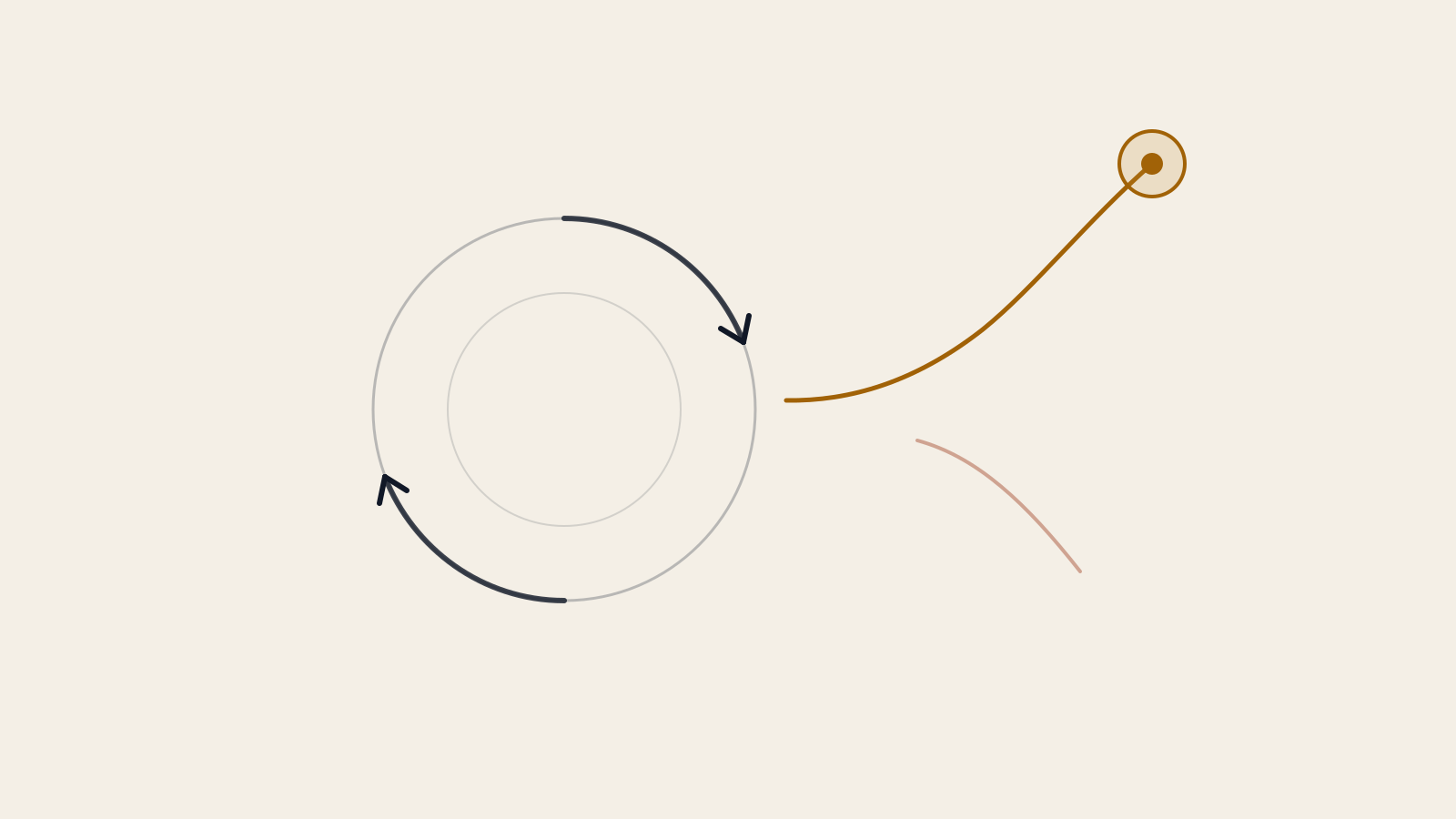
You may have read plenty about habits, about "letting go", about "changing your mindset". But one thing is rarely said plainly: you cannot change what you cannot clearly see. And most of what drives daily life sits below the line of awareness — it runs quietly, repeats, and we call it "personality", "fate", or "that's just how life is".
This article is not for reading and forgetting. It is a tool. By the end, you will be able to draw your own loop map — concrete enough to act on, rather than stopping at "I understand it but I still do it".
What a loop actually is
A loop is an automatic chain of reactions, triggered by a familiar signal, leading to a familiar behavior, giving a hidden short-term payoff, and dragging a repeated long-term cost.
The key lies in the words hidden payoff. If a loop only harmed you, you would have dropped it long ago. It survives because it is protecting you from something you would rather not feel: rejection, being seen as not enough, losing control, being abandoned. A loop is an old solution to an old fear. The problem is the solution has expired, while the cost still charges you every day.
The four layers of a loop
- Trigger — the situation, words, glance, or inner sensation that starts the chain.
- Reaction — what you do almost automatically: withdraw, please, delay, control, attack, justify.
- Hidden payoff — what you gain in an instant: avoiding a hard feeling, keeping a safe image, not having to face it.
- Cost — what slowly erodes: relationships, opportunities, health, self-respect, or time you cannot recover.
When you can read all four layers for a specific situation, you are no longer inside the loop blindly. You stand outside and watch it run. That is the first moment you have the right to choose again.
The 7 most common loops
This is not a diagnostic chart. These are seven recurring patterns to help you recognise yourself. You may carry more than one.
- The pleasing loop. Trigger: a sense someone is unhappy. Reaction: take on more, say "it's fine", drop your own needs. Payoff: peace, being seen as good. Cost: burnout and quiet resentment.
- The procrastination loop. Trigger: a task that stirs fear of not being good enough. Reaction: slide to something easier. Payoff: avoiding helplessness right now. Cost: tasks pile up, self-trust erodes.
- The control loop. Trigger: uncertainty. Reaction: hold everything, check every detail, never delegate. Payoff: false safety. Cost: overload, people around you suffocate.
- The proving loop. Trigger: a sense of not being enough. Reaction: do more, achieve more to be recognised. Payoff: a short dose of approval. Cost: never enough, rest feels guilty.
- The withdrawal loop. Trigger: risk of being hurt or of conflict. Reaction: go silent, disappear, cut connection. Payoff: avoiding pain now. Cost: prolonged loneliness, stacked misunderstandings.
- The judgment loop. Trigger: seeing something different or uncomfortable. Reaction: label, criticise, place yourself above. Payoff: feeling right. Cost: isolation, hard to learn anything new.
- The numbing loop. Trigger: a strong emotion rising. Reaction: stay busy, scroll, eat, keep occupied so you don't feel. Payoff: not touching the pain. Cost: losing contact with yourself, blurred decisions.
How to map your own loops — step by step
This is the practice. Take a notebook or a blank page. A map only matters when it is yours, written from your real situations.
Step 1 — Pick a real, recent situation
Don't pick a big theme ("my life is stuck"). Pick one specific moment in the last 7 days that left you uncomfortable, regretful, or thinking "here we go again". The more specific, the more readable the map.
Step 2 — Separate the four layers
Write four lines for that moment: what the trigger was, how you reacted, what you got right then, and what you are paying for in the long run. Write honestly, without sugar-coating or self-blame.
Step 3 — Find the root fear
Ask: "If I didn't react that way, what am I afraid would happen?" The answer is usually short and very old — fear of being left, of being a failure, of not being loved. This is the root. You don't need to erase it, only to see it steering.
Step 4 — Place an insertion point
Between trigger and reaction there is always a tiny gap. The insertion point is a minimal action you place into that gap: one long breath, one question, standing up for water, writing one line. You don't need to change your whole self. Only one point small enough to actually do, real enough to make a difference.
Step 5 — Define the replacement reaction
Write what you want to do instead of the old reaction — so specific that another person could follow it. For example: instead of "I'll please less", write "when asked to take on more, I'll say: let me think on it and answer by this afternoon".
A one-line map template
When [trigger], I usually [reaction] to [hidden payoff], and the cost is [cost]. The root is fear of [fear]. My insertion point is [small action]. My new reaction is [specific line/behavior].
A 21-day path to turn the map into real life
Understanding a loop is not enough. The brain only relearns through repetition in real situations. Here is a 21-day frame, one small action a day, with no new slot needed in your calendar.
- Days 1–7 · Observe. Each evening write one map line for one situation that day. Don't change anything yet. Just practise seeing.
- Days 8–14 · Insert. Pick the most prominent loop. Each time it triggers, do exactly one insertion point. Note whether it happened, without judgment.
- Days 15–21 · Replace. Practise the new reaction in a real situation at least once a day. At day's end, write: which cost did I pay less for this time.
After 21 days, what usually changes is not "the loop is gone" — it is that the gap between trigger and reaction widens. In that wider gap, you get to choose. That is real freedom, not a slogan.
Four mistakes that keep the map from working
- Too greedy. Trying to fix five loops at once. Choose one. Just one.
- Turning it into self-blame. The map is to see, not to convict yourself. A loop once helped you survive; look at it with respect.
- An insertion point that is too big. "I'll always stay calm" is not an insertion point. "I take one breath and count to three" is.
- Skipping the log. Without writing, the brain has no data to learn from. One line a day is enough.
This piece shares personal experience and self-practice. Some loops have deep roots linked to trauma; if you feel overwhelmed, slow down and seek professional psychological support when needed. It does not replace medical care or therapy.